A Late 19th Century Illuminated South African Travel Diary
A Late 19th Century Illuminated South African Travel Diary
Author: ‘F’
Title: Late 19th Century Travel Manuscript: A Christmas under Canvas in Sunny Africa / Cape Town to Johannesburg by Rail
Date: December 1898 – August 1899
Place: Cape Town and Johannesburg
Dimensions: 4to. 24cm x 19cm.
Watercolour title page + 39 leaves + 1pp on ruled paper.
Later plain blue cloth covered boards. Original marbled endpapers preserved and bound in after new, plain endpapers.
A charming, late Victorian, South African manuscript in three parts, illustrated throughout by the author in ink and watercolour, a laid in original photograph, and laid in photographic reproductions. The first part: a Christmas camping holiday at Fish Hoek, the second of a trip by rail to Johannesburg and the third part the author’s impressions of that city at the height of the gold rush, on the eve of the Second Anglo Boer War.
Part one: “A Christmas under Canvas in Sunny Africa” details the author and his traveling party’s excursion by train from central Cape Town to Fish Hoek, where the party camped out between Christmas and New Year 1898/9. Among them was a Mr. Heineman, who, the author remarks, is “a brother of the firm of London Publishers” (William Heineman). The diary offers a glimpse into the retail trade over Christmas, details what the campers ate and drank, and what the Fish Hoek valley looked like before it was developed into a large suburban hub – also offering some insight into the antagonism that existed between the Dutch and English at the Cape. From the diary the author remarks:
“Only about 5 or 6 houses in this place, they are mostly Dutch, low plain buildings, very unattractive to the eye in beauty of architecture, but very plain and steadily built...The ground our camp was in belonged to a Dutch man, Mr De Villiers...he was a typical (Jan Tromp? Farm tramp?), as broad as he was long almost, rough and hardy, as it were (sic) sensible to be...He had settled here 30 years ago and the ground was given to him, commenced farming, rearing stock and by these means he is today worth a good sum of money. We met the gentleman in question on returning from our morning immersion and he commenced talking rapidly in Dutch to us...“We don’t speak Dutch”...He was very surprised and apparently disquieted and said in broken English something like this – You be ferry slow, I pick up ze English in one day, why don’t you do same with ze Dutch. I don’t speak English very well, but I understand it well. You no good of you no speak Dutch here. We assured him we would pick it up shortly...infernal to us tho’ it seems”.
This part is handsomely illustrated with a mixed media, watercolour and collage title page, depicting a beach with a palm tree in the foreground, halfway up which a monkey climbs towards the fronds, over which a black and white photographic reproduction of Cecil John Rhodes is pasted. A canoe with 8 rowers can be seen in the ocean – middle-ground - with a ship and mountains (possibly the Hottentots Holland) in the background.
The author includes two further full page watercolour illustrations: the first titled ‘Bathing Place’ and of other of their campsite. A further black and white, pen-ink sketch of the Fish Hoek train platform (merely a few wooden planks) and a small rowboat on the sands in the foreground, looking out towards the valley with farmhouses and campsite in the middle-ground, and a final sketch of the Fish Hoek valley, with moonrise over False Bay, flanked by mountains on either side. The illustrations show an undeveloped valley, with the campsite and 3 farmhouses the only architecture visible. At the end of the work, before an ‘editor’s note’, are two black and white photographic reproductions, one of a wooded area and the other a rocky outcrop, possibly a view from Clovely Beach towards Kalk Bay.
Part two: Cape Town to Johannesburg by Rail gives an account of a rail journey, departing from Cape Town on 2 May 1899 and traveling through Frazerburg, Naauwpoort, Maatjiesfontein, Bloemfontein and Vereeniging, where there is a lengthy description of a search conducted by a Boer official. The description ends with the author arriving at Park Station.
Adorning this part of the work is a monochrome photographic reproduction titled ‘Cape Town Station’ as frontispiece, showing a large terminal building, with cast iron frame and wrought iron scroll work. This is in fact Park Station, Johannesburg which was commissioned by the Zuid-Afrikaansche Republiek, designed by Dutch railway architect JF Klinkhamer and built in 1896. Only part of Klinkhamer’s original design was completed, as building was interrupted by the Jameson Raid (Woodgate, F. Old Park Station: Draft Statement of Significance, 2015).
Further illustrations of ‘Bloemfontein Cathedral and Bishop’s Lodge’, ‘Convent of the Holy Family, Bloemfontein’ and a portrait of Milner. The final page contains a monochrome view of the approach to Park station.
Part three: Johannesburg or “The Golden City” is an account of the author’s stay there from May to August 1899. It is perhaps the richest of the three parts and contains, among other musings, the author’s comments on:
The stock exchange, in which he tells of friend who lost all his money speculating “on change...It’s nothing else but gambling, pure & simple…a lot of speculation is done here”
The sweepstakes: “It is on a certain horse race that this sweepstakes is (based)...If I draw a winning number & the corresponding horse (wins) I get about 2000£…These sweepstakes are not permitted in the Colony being to their laws and statutes illegal. These…proprietors slap 10% on all prizes…(If) you won a prize of £1000 you would receive 900, the other 100 for the proprietors. That’s not bad.”
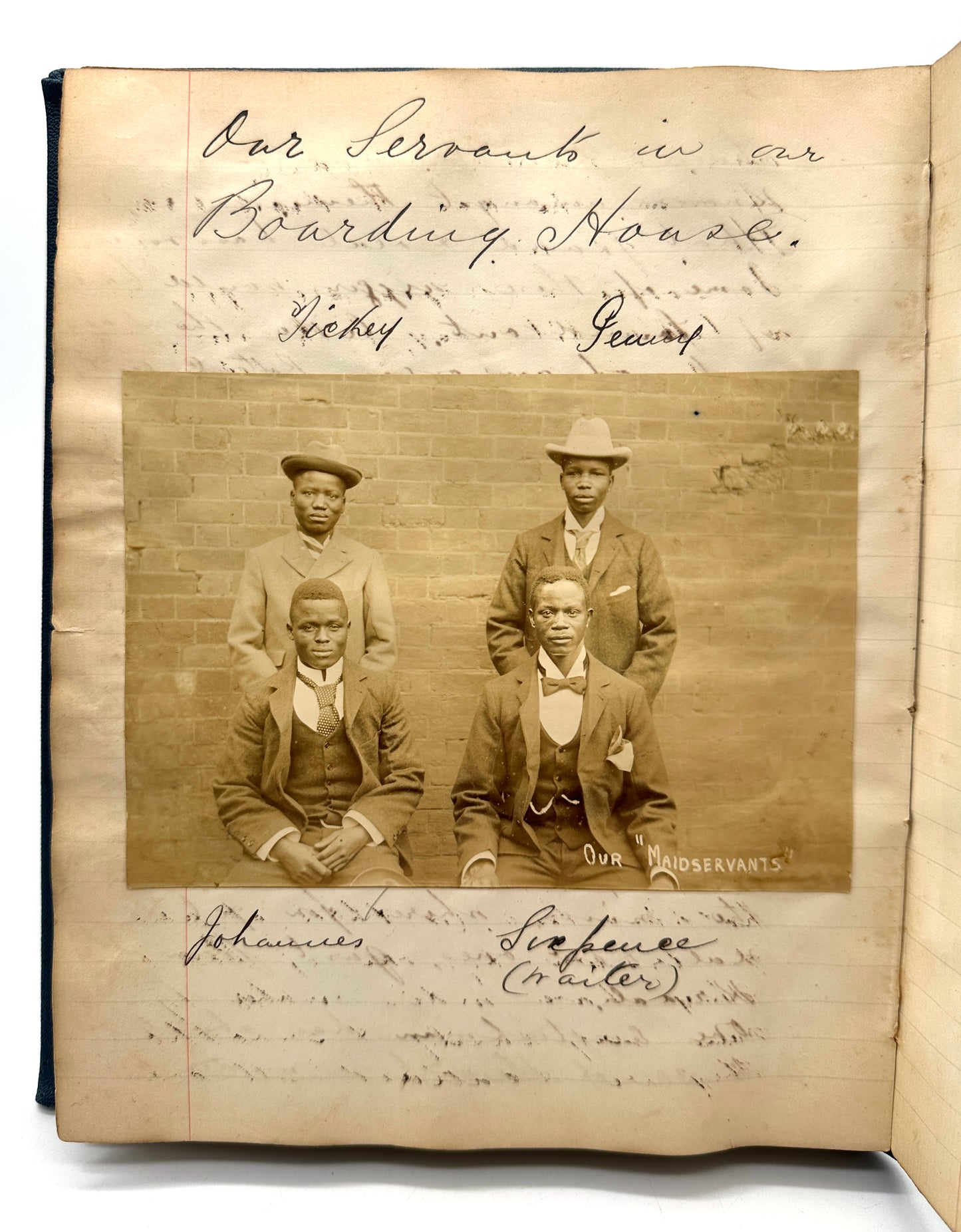
Race and labour relations: “The natives here are not treated anything like so well as at Cape Town…they are not allowed on the footpath or causeway under any circumstances, and are not allowed out after 9 O’clock at night...Some of them have the making of fine men, if they had the advantages of Englishmen, but of course they are treated like dogs and kept down...The Englishman has about 20 to 30 of these boys under him and to make them work & afraid of him, he has to kick & cuff them, ad lib.”
Rickshaw drivers: adorned in feathers and with horns on their heads, one with a “jacket made from an old union jack, knickers of the same, on his legs a tuft of white hair & long, & a bell fastened to one of his legs”
The upper classes: “I have seen some of the smartest “turnouts” (horse-drawn carriages) here that I have ever seen in my life. Those belong to the millionaires, of which lucky beings (or unlucky which?) there are not a few…They live out in the suburbs and the suburbs of this town are very nice places to dwell in. I will say, I never saw better appointed residences any where than some in the suburbs of Johannesburg. They are simply miniature palaces, standing in their own grounds, with nicely laid out gardens, tennis courts invariably etc. etc. They really make one feel not a little discontented with one’s lot in looking at these people living in the lap of comfort and luxury.”
Joubert Park: so named “after one of our most famous generals, who at the time of writing this, is busy preparing to fight against England.”
Transportation: “For nearly every body, man woman or child ride a bicycle here. I never saw so many cycles in any town I have been, considering the population...And the roads are so bad, tyres keep breaking and wearing out, but there are some splendid runs around the suburbs.”
Accommodations, theaters, music houses and the great change artiste Ugo Biondii who was in town “drawing big houses at the Empire (theatre)”.
Fashion: the author notes the more casual dress of men, but that the “female portion here display very nice taste in dress, for you see in Cape Town the Malay women do all the “faffing” and the English women have to dress quietly, but here, are no Malays, so the combination colours displayed is very charming.”
This part is generously illustrated in black and white photographic reproductions, with views of the various commercial centers, streets and buildings of Johannesburg, an original photograph titled “Our Maidservants” showing 4 smartly dressed black men posing in front of a brick wall, various images of ‘natives’ and what the author calls “studies in children”, mining operations in Paarl and a fold out “Bird’s-eye view of Johannesburg”.
Slightly foxed, especially latter leaves, some offsetting to the illustrations, but Very Good overall.
Couldn't load pickup availability